Creditor Corner

The ultimate weekly source for great financial and restructuring news affecting creditor rights specifically curated for you

Weekly News – March 27


Kaplan defers Multi-Color roll-up, Venue up to the Third Circuit while Congress gets involved, Serta saga comes to a head, and much, much more...

Creditor Corner

Your weekly curated content from the Creditor Rights Coalition

Over 3,700 member subscribers and growing!

We bring you exclusive content from leading data and research providers 

Sign Up Here

?In this Week's Creditor Corner

Kaplan defers Multi-Color DIP roll-up decision, Venue goes up to the Third Circuit, even Congress getting involved in the venue fight, Serta saga comes to a head, and much, much more...

Advocacy in Action

CRC joins industry associations opposing Optimum's challenge of Cooperation Agreements

Featured Content

Bi-Partisan Legislation Aims to Restore Integrity to Corporate Bankruptcy

By Cliff White

Scroll through to read all ou?r content?

Tweet of the week

bears hibernate eventually...

Click Above to Access Content

Exclusive Content

Multi-problems in Multi-Color

Click above to access content

One-time registration required

Our take:

Judge Kaplan deferred $125 million of the $250 million DIP roll-up pending the upcoming confirmation hearing. At the same time, the Third Circuit is set to hear the venue appeal while Congress takes up venue reform (see below)... Could Kaplan being feeling the heat?

Exclusive Content

Kaplan venue ruling up to the Third Circuit

Click above to access content

Professor Levitin Takes on the Establishment

fighting the good fight!

Click above to access content

In the news

Litigation finance is binary??

Click above to access content

Featured Content

Congress taking on venue reform (again....)

?Bi-Partisan Legislation Aims to Restore Integrity to Corporate Bankruptcy 

?

Last week, Justin Ellis of MoloLamken LLP wrote an excellent analysis in this space on the recently decided Multi-Color Corp. bankruptcy venue decision.   In his opinion, Bankruptcy Judge Michael Kaplan approved venue in the district of New Jersey based solely on a bank account opened in the name of a shell affiliate funded on the eve of filing.  None of the 56 debtors had any other known connections with New Jersey.  Judge Kaplan agreed with creditors and the U.S. Trustee that the debtors manufactured their own venue and that did not “sit right” with the judge either.  But the judge concluded only Congress can fix the problem.


In throwing in the towel on trying to police cynical manipulation of the law, Judge Kaplan put the definitive exclamation point on the demise of bankruptcy venue statutes.  Loopholes have swallowed the statute.  As seen in such infamous cases as Sorrento Pharmaceuticals (S.D. Tex.), Sysorex Government Services (S.D.N.Y.), and many others, a handful of big-case chapter 11 lawyers can select their judge and district by opening a bank account (even just by paying a lawyer’s retainer in the favored jurisdiction), incorporating an affiliate at the last minute, opening a post office box, or engaging in countless other shenanigans.


Although there is a lot to disagree with in Judge Kaplan’s opinion -- such as reading legislative inaction as Congressional consent (DOJ historically rejects such use of legislative history), taking a narrow reading of the “interests of justice” standard to exclude consideration of the integrity of the bankruptcy system, and reaching a perplexing conclusion that it was too late to consider discretionary transfer even though venue objections were raised before the first day hearings – he issued a clear challenge to Congress. 


Representatives Zoe Lofgren (D-Ca.) and Ben Cline (R-Va.) met the challenge last Thursday by introducing bi-partisan bankruptcy venue reform legislation.  The bill has been introduced before, but a bevy of recent egregious actions by corporate insiders to disenfranchise smaller creditors and larger disfavored creditor groups have galvanized reform efforts. 


The Bankruptcy Venue Reform Act (H.R. 8111) contains four key features:


          (1)      A company can only file chapter 11 where it has its principal place of business or principal assets.  In a change from existing law, mere incorporation in a favored venue will not be enough.  And a company will generally be bound by its declaration of principal place of business made in SEC filings.


          (2)      The current exception that allows all affiliates to file in the same district will be dramatically narrowed.  Under the bill, the debtor with connections to the district where the case is filed generally must own the other filing affiliates.  Also, changes to ownership and control made within one year before filing or for the purpose of establishing venue will not be recognized.  This should end the increasingly common practice of using a newly created company or bringing a shell company out of mothballs to establish venue.


          (3)      Manipulation of principal assets will similarly be restricted by excluding transactions made within one year or for the purpose of establishing venue.  Importantly, principal assets will generally exclude cash.  That will prevent a mere bank account or payment into a law firm retainer account from qualifying as a principal asset to evade the venue requirements.


          (4)      Courts must police the venue rules more strictly by immediately dismissing or transferring improperly filed cases and holding hearings within 14 days after objections after filed.  This will end delaying tactics that are then disingenuously used to justify retaining the case in the wrong jurisdiction, as was done in Multi-Color and many other cases.


Taken together with other provisions of the bill, the legislation should vastly curtail the increasingly brazen judge and forum-shopping by debtor lawyers who control the biggest cases and currently dangle the carrot of future filings of headliner cases which bring prestige to local courts and lots of money to the local lawyers.  Now maybe some of the districts that have lost mega-cases to magnet districts will receive their proper share of filings, too.[5]


*Cliff White was the head of the Justice Department bankruptcy “watchdog,” the U.S. Trustee Program, for 17 years until his retirement in 2022.

?

Copyright Creditor Rights Coalition 2026

Click above to access content

Advocacy in Action

CRC Joins the Fight Against Optimum

Click above to Read our Brief

Our take:

Cooperation agreements are under attack—but they’re the glue holding credit markets together. These agreements aren’t collusion; they’re a defensive shield against coercive liability management exercises  that strip value from minority lenders. Without them, creditors face a “prisoner’s dilemma”: participate or get wiped out. These agreements preserve pro rata treatment, boost lender confidence, and lower borrowing costs. Antitrust claims miss the mark—this is contract enforcement, not market manipulation. Undermining cooperation agreements would raise costs, chill lending, and destabilize restructurings.

Bottom line: eliminate cooperation agreements, and you risk breaking the modern credit market.

Exclusive Content

Serta saga comes to a head....

Click above to access content

Data download

BDC redemptions continue....

Click above to access content

Special Feature

What's under the turd....

Click above to access content

One-time registration required

Exclusive Content

It's a buyers BSL market 

Click above to access content

One-time registration required

Upcoming Events

Bankruptcy and Restructuring Primer for the C-Suite and the Board

April 22, 2026

Learn More

Octus: Inside Credit Investors Use of AI

April 23, 2026

Learn More

EMTA Forum: 2026 EM Corporate Bond Outlook in Boston

April 23, 2026

Learn More

Valcon

May 4 - 6, 2026

Learn More

The Data Download

Bringing Transparency to the Bankruptcy Process

Click Above to Access The Data Download

Our Take:

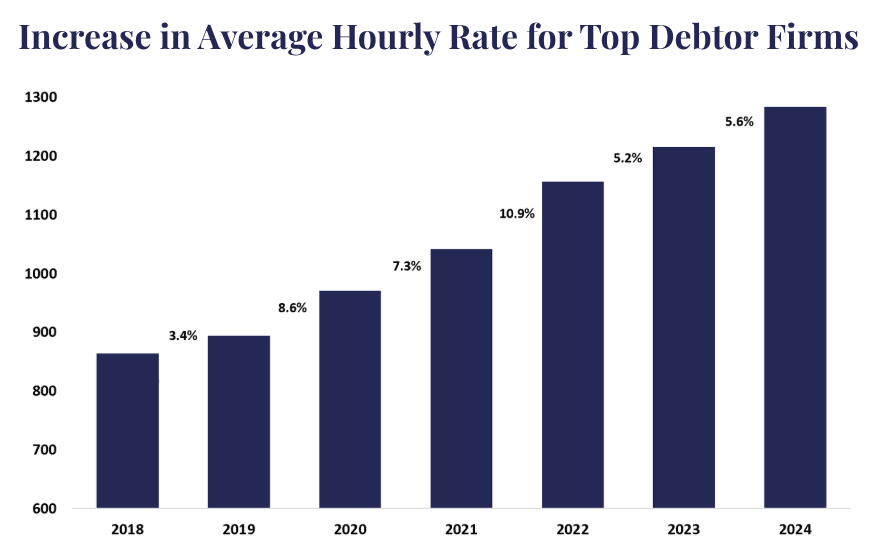
The Daily Cost of BK Legal fees Are Increasing.

Are we shocked? No.

We took a deep dive to see what is driving up the daily cost of restructurings and the culprit: Increasing Legal Hourly Rates. We analyzed final fee apps for top debtor law firms from 2018 to 2024 and found average hourly legal fees have increased by over 65% since 2018. Maybe a little bit of sunlight is the right disinfectant to help remedy the problem....

Thank You To Our 2026 Sponsors

Diamond Sponsor

Platinum Sponsors

Gold Sponsors

Silver Sponsors

Have Something to Share?

Email us at info@creditorcoalition.org