
Special Feature: Should Bankruptcy Judges Mediate Cases Pending Before Them?
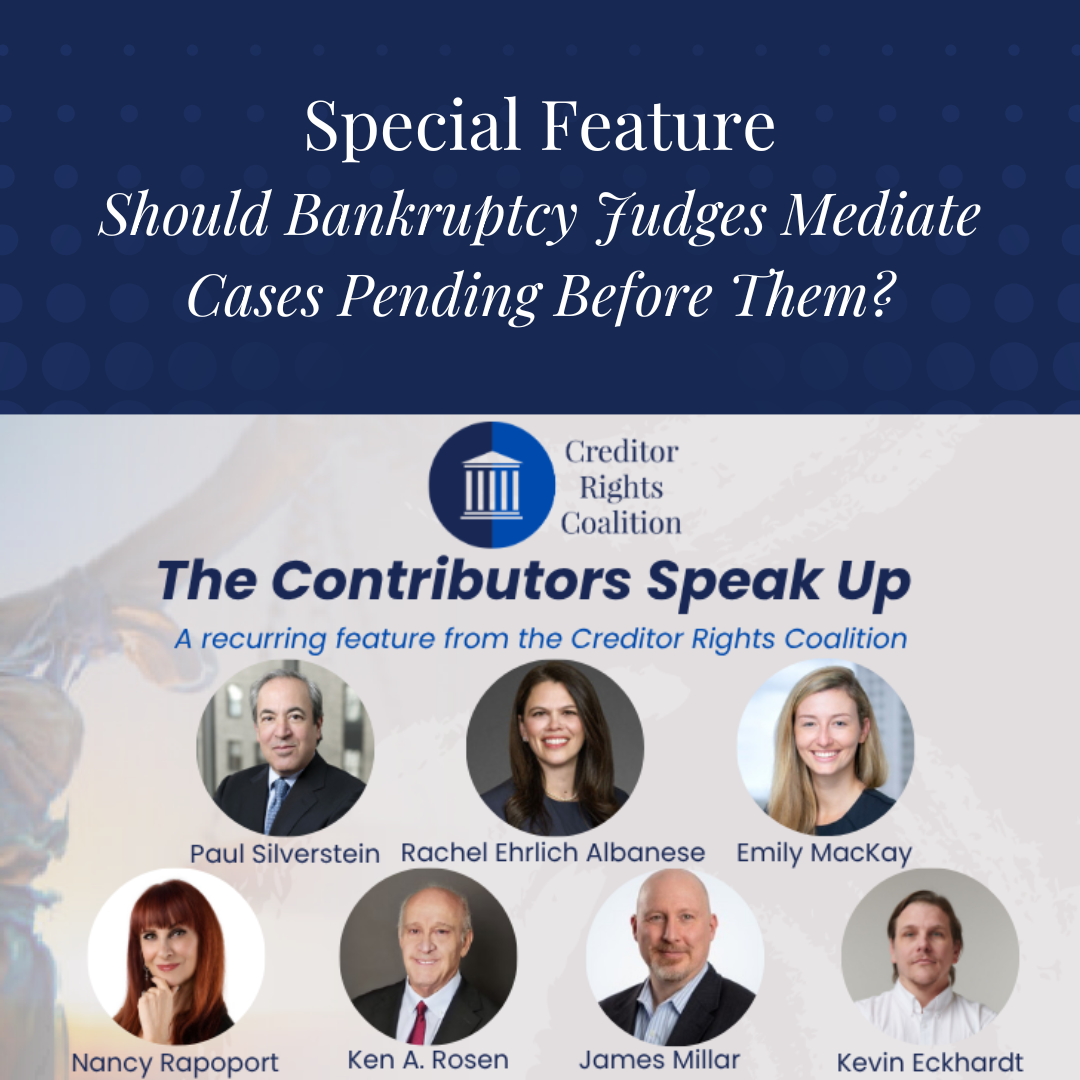
A growing debate has emerged within the restructuring community over whether bankruptcy judges should personally mediate cases pending on their own dockets.
The issue has drawn increased attention following Judge Michael Kaplan’s participation in mediation efforts in several cases before him.
The contributors to this special feature approach the question from a variety of perspectives. Some argue that judicial mediation is little different from a traditional settlement conference and that active judicial involvement can help bridge difficult disputes, reduce costs, and facilitate consensual resolutions in increasingly complex Chapter 11 cases. Others contend that formal mediation differs in important respects from traditional settlement conferences and raise concerns regarding confidentiality, judicial neutrality, party consent, public confidence, and the potential impact on subsequent judicial decision-making. Several contributors focus on the governing statutes, ethics rules, and local bankruptcy rules, suggesting that greater procedural clarity may be warranted regardless of the ultimate policy outcome.
More broadly, the debate raises important questions about the evolving role of bankruptcy judges in today’s large and complex restructuring cases, where courts increasingly serve not only as adjudicators, but also as active case managers and facilitators of negotiated outcomes.
Please read what our experts had to say below.
As always, the views and opinions of our Contributors represent the personal views or opinions of the author and should not be attributed to their respective firms or the Creditor Rights Coalition.
Should Bankruptcy Judges Mediate Cases Pending Before Them?
By: Paul N. Silverstein
Hunton Andrews Kurth LLP
Introduction
When Bankruptcy Judge Michael Kaplan (D.N.J.) acted as a mediator in Multi-Color Corp., a Chapter 11 case in which he is the presiding judge, some commentators found his dual role as mediator and presiding judge highly unusual and troubling. As previously reported in CRC on May 29, 2026, Judge Kaplan’s response, in an informal podcast, was not surprising: “I’ve been shocked by the attention the issue … [of] my mediating cases that are before me has gotten because in my view it’s just a label … . [B]ankruptcy Judges … have always brought parties into chambers in an effort to settle matters when it’s consensual.” (Emphasis added.) Indeed, most of us who have practiced in major cases over the years have, at times, been brought into chambers for settlement conferences – – either by the Court itself, or at the request or suggestion of one or more parties – – in efforts towards consensual resolution of disputes. In fact, a former Bankruptcy Judge was known to tell parties that he was like “a monkey with a gun” such that they were better off settling than risking an unexpected or surprising ruling.
Multi-Color Background
In Multi-Color, after an earlier mediation conducted by a retired Judge failed to produce a comprehensive settlement, Judge Kaplan entered an Order appointing himself “consensual mediator” while continuing to preside over the Chapter 11 case. The Mediation Order was entered with the unanimous consent of the principal mediation parties, and it expressly provided that Judge Kaplan’s mediation role would not create a conflict or be grounds for seeking his disqualification or recusal from the case. The Order was unusual because Judge Kaplan remained the presiding judge while he served as the mediator in disputes over the plan and disclosure statement. The mediation was time-limited and aimed at resolving the remaining plan disputes before confirmation. The Multi-Color mediation was a success and, though a very contentious case on many levels, the Chapter 11 Plan was confirmed in less than 90 days.
Settlement Conferences and Mediations Are Very Different
Settlement conferences by bankruptcy judges are common and encouraged, including under Bankruptcy Rule 7016 which incorporates F.R.Civ.P. 16 in adversary proceedings (as opposed to the Chapter 11 case generally). Yet there are many bankruptcy judges who do not use settlement conferences and would never even consider appointing themselves as a mediator because they view themselves as impartial arbiters of disputes, i.e., judicial officers who act only upon evidence brought before them – – not advocates or, in essence, parties to the case much like judges or (until 1973) referees under the former Bankruptcy Act of 1898, as amended.
Settlement conferences, however, are very different from actual mediations – – with a mediation order, mediation statements and, typically and significantly, confidential communications or caucuses with the mediator without all parties present. In a settlement conference, the Court facilitates negotiations while remaining the adjudicator. Bankruptcy court judges meet with the parties, discuss strengths and weaknesses, and facilitate negotiations. On the other hand, in a true mediation involving confidential caucuses and ex parte disclosures, if the presiding judge is the mediator he or she would hear and obtain knowledge of matters that would not be heard in the adjudicative role.
Although far from common, presiding bankruptcy judges have in certain circumstances occasionally acted as formal mediators. For example, former Judge Christopher Sontchi (D. Del.) acted as a mediator in the Paragon Offshore Chapter 11 case over which he presided; and former Judge Robert Drain (S.D.N.Y.) acted as mediator in the Hostess Brands Chapter 11, where he insisted on a mediation between the debtor and the bakers’ union in a final attempt, albeit unsuccessful, to avoid a liquidation of the business and loss of thousands of jobs. To my knowledge, neither received negative commentary or criticism regarding such efforts.
Whether bankruptcy judges can or should mediate cases pending before them are different questions. While there is no per se prohibition on a bankruptcy judge acting as a mediator in cases in which he or she presides, the question is whether the trial judge should act as an actual mediator. The general answer should be no, although there will be exceptions which, like Multi-Color, can be successful. Arguments in favor of having the presiding bankruptcy judge act as mediator include that the judge knows the case better than anyone else and the judge’s assessment of the merits carries considerable weight and can break an impasse. Arguments against the trial judge acting as mediator include that if the judge hears confidential settlement positions, such disclosures may affect later rulings. One cannot erase what one hears or reads. Because effective mediations typically involve private caucuses without all parties present, they are generally viewed as inconsistent with a judge’s adjudicative role. For those reasons, the roles are generally separated: The presiding judge handles the litigation; mediation is handled by another sitting judge, a former judge, or a private mediator. This preserves the neutrality of the trial judge while still giving the parties access to an experienced mediator. Separating the adjudicator from the mediator is generally the obvious and better practice. It avoids any appearance that the substance of the mediation could influence subsequent judicial rulings, particularly if the mediation fails. However, in complex bankruptcy matters – – where the parties are represented by experienced counsel and understand the process – – the presiding judge can sometimes be a constructive mediator if everyone genuinely consents. But, even then, it is unusual and judges generally prefer to use a third party for confidential mediations.
Relevant Rules and Statutes
While there is no rule that categorically prohibits a bankruptcy judge (or any federal trial judge) from acting as either a settlement facilitator or as a mediator in a case pending before that judge, several sources of law and ethics bear on the issue. As indicated, F.R.Civ.P. 16 and Bankruptcy Rule 7016 expressly authorizes the court to facilitate settlements. Among the matters that may be considered at pretrial conferences are “settling the case and using special procedures to assist in resolving the dispute.” Thus, Rule 16 clearly contemplates judicial involvement in settlement efforts. The Judicial Conference of the United States Committee on Codes of Conduct issued Advisory Opinion No. 95, “Judges Acting in a Settlement Capacity.” The Opinion concludes that a judge may participate directly in settlement discussions in a pending case; ex parte communications during settlement efforts present ethical concerns; and judges should avoid conduct that compromises, or appears to compromise, their neutrality.
Canon 3 of the Code of Conduct for United States Judges similarly provides that a judge should perform judicial duties fairly, impartially, and diligently. The Commentary to Canon 3 specifically recognizes that a judge may encourage and seek to facilitate settlement but should not act in a manner that coerces any party into surrendering the right to have the controversy resolved by the courts. If all parties expressly and genuinely consent to the presiding judge acting as a mediator in a confidential mediation, there should be no issue of coercion, but a question is whether all parties actually consented. If, for example, a representative committee consents, is such consent binding on all of its constituents? Similarly, in the event of an unsuccessful mediation, can a party to the mediation later object to the judge/mediator adjudicating the dispute on the ground that its consent was coerced?
If a mediation with the presiding judge as mediator is not successful and/or not consented to by all parties in interest, 28 U.S.C. § 455 may be the strongest statutory basis for challenging, and seeking removal of, a judge who acts as a mediator in a case that remains pending before that judge. The key provision of Section 455(a) provides: “Any justice, judge, or magistrate judge of the United States shall disqualify himself in any proceeding in which his impartiality might reasonably be questioned.” The test is objective: would a reasonable, informed observer question the judge’s impartiality? A party challenging the judge’s dual role could argue that a mediator necessarily receives confidential information, as the mediator will typically hear each party’s settlement bottom line, litigation strategy, and risk assessments. The judge cannot realistically “unlearn” that information when later ruling on disputes if the mediation is unsuccessful. Therefore, a reasonable observer could question the judge’s impartiality. That argument under Section 455(a) does not require proof of actual bias. Section 455(b)(1) requires recusal where the judge has “personal knowledge of disputed evidentiary facts concerning the proceeding.” (Emphasis added.) If in a confidential caucus a party disclosed facts that are genuinely disputed and not otherwise in the record, an argument could be made that the judge has acquired “personal knowledge of disputed evidentiary facts.” The counterargument is that Section 455(b)(1) refers to extrajudicial knowledge, not information learned in the course of the mediation. Courts have distinguished knowledge acquired while performing judicial duties from the type of personal knowledge that triggers mandatory recusal. The concern is not that the judge has become a witness or has acquired forbidden factual knowledge. Rather, it is that the judge’s confidential exposure to the parties’ private mediation communications creates an appearance that later rulings could be influenced by information unavailable to the opposing party or outside the judicial record. That is precisely the kind of concern Section 455(a) was designed to address.
An interesting wrinkle is that 28 U.S.C. Section 455(e) permits waiver of Section 455(a) after full disclosure on the record, but does not permit waiver of the specific grounds listed in Section 455(b). That would have had direct relevance to Judge Kaplan’s Mediation Order in Multi-Color if the mediation had failed. The parties stipulated that his serving as mediator would not be a basis for recusal. If the only possible objection is under Section 455(a), all party consent may be effective. If the mediation somehow created a Section 455(b)(1) issue – – for example, by giving the judge personal knowledge of disputed evidentiary facts – – that ground would not be waivable. Thus, Section 455 addresses whether, after acting as a confidential mediator, the judge may continue to adjudicate the same case without creating an appearance of partiality. That strikes at the heart of the concern raised by judges mediating cases over which they preside as judges.
1) Read the Statute, 2) Read the Statute, 3) Read the…Local Rules!*
By: Rachel Ehrlich Albanese and Emily MacKay
Debevoise & Plimpton LLP
Much has been written in recent months regarding the novel but increasingly utilized practice of a bankruptcy judge mediating a case over which he is presiding (“judicial self-mediation”). To date, however, commentators have failed to discuss one crucial factor: while a combination of federal procedural rules and statutes (including section 105 of the Bankruptcy Code) afford bankruptcy judges the general authority to hold settlement conferences and engage in alternative dispute resolution, mediations are governed by separate, specific local rules and procedures.
When read in the context of judicial self-mediation, do the local rules and procedures governing mediation in the bankruptcy courts in the Southern District of New York and the District of New Jersey permit such a role? Or does judicial self-mediation contravene the very rules judges put in place to guide behavior? We found that the rules and procedures in these jurisdictions both permit and prohibit the practice, to varying degrees. Judicial self-mediation raises issues in connection with confidentiality, conflicts, and compensation. As discussed below, these issues could be addressed by revising the local rules expressly to permit judicial self-mediation or to make clear that it is not permissible.
Confidentiality
The local rules governing confidentiality in a mediation are not uniform. For example, Section 5.0 of the Procedures Governing Mediation of Matters and the Use of Early Neutral Evaluation and Mediation/Voluntary Arbitration in Bankruptcy Cases and Adversary Proceedings (the “S.D.N.Y. Procedures”), as referenced in S.D.N.Y. LBR 9019-1, contemplates complete confidentiality between the mediator and the parties, on the one hand, and the court, on the other. It provides that “[a]ny statements made by the mediator, by the parties or by others during the mediation process shall not be divulged by any of the participants in the mediation (or their agents) or by the mediator to the Court or to any third party. All records, reports, or other documents received or made by a mediator while serving in such capacity shall be confidential and shall not be provided to the Court, unless they would be otherwise admissible” (emphasis added). Implicit in this rule is that the mediator and the court will not be the same person, given the impossibility of preventing divulgence to the court when the judge also serves as mediator. Assuming the S.D.N.Y. were to explicitly authorize judicial self-mediation, a revised rule would provide a clear standard for confidentiality when one person is both presiding judge and mediator.
In contrast to the S.D.N.Y. Procedures, D.N.J. LBR 9019-2(k) is more broadly worded, providing instead that “a mediator, party, or other participant in the mediation may not disclose to an entity or person who was not a participant in the mediation any oral or written communication concerning the mediation” (emphasis added). Typically, where the presiding judge is not the mediator, this rule would prohibit the judge from receiving information or communications exchanged as part of the mediation. As written, the rule would allow a presiding judge serving as mediator to access all mediation information and communications. To the extent the rule is driven by a policy of ensuring that parties to a mediation are able to exchange communications and information freely without prejudicing their positions before the court in the event mediation is unsuccessful, the rule may warrant re-examination if the D.N.J. were to explicitly authorize judicial self-mediation.
Conflicts
D.N.J. LBR 9019-2(c)(2) provides that if any party believes the mediator has a conflict of interest, it must promptly advise the mediator, and if the mediator does not withdraw, the party can seek a determination of the issue from the court. This grants authority to the mediator who has not withdrawn, wearing his or her hat as the judge, to review his or her decision not to withdraw. A revised rule in connection with judicial self-mediation may instead provide that as a next step, the matter is referred to another judge on the bench rather than the mediator/judge presiding over the matter at hand. This revised rule could also provide for referral in situations where the parties determined there was a conflict regarding the judge/mediator that required resolution after the parties already had consented to judicial self-mediation. These changes would address the inherent conflict of a judge ruling on situations involving his or her own role or decisions (and for what it is worth, similarly sensitive matters of recusal and stay pending appeal might also benefit from a rule requiring referral).
Section 2.3 of the S.D.N.Y. Procedures presents even more complexity, providing for disqualification of a mediator for bias or prejudice, if not disinterested, or if “28 U.S.C. § 455 would require disqualification if that person were a justice, judge or magistrate.” 28 U.S.C. § 455(b)(3) includes as grounds for disqualification situations where a judge “has served in governmental employment and in such capacity participated as counsel, adviser or material witness concerning the proceeding or expressed an opinion concerning the merits of the particular case in controversy” (emphasis added). That second prong presents a double conundrum for a judge-mediator. On one hand, it is likely that any judge, simply by carrying out his or her judicial duties, will have issued multiple rulings or made comments during the pendency of the case, involving matters such as dismissal, DIP financing, cash collateral, or other controversies, that concern the merits of the controversy to be mediated. Under the current rule, such opinions arguably could preclude a judge from serving as mediator. Conversely, the court, in its capacity as mediator, may well express opinions to the parties, individually or collectively, regarding the merits of their claims—standard components of a mediator’s role—in a manner that could then disqualify the judge-mediator from serving as judge. If judicial self-mediation is to be permitted, a revised rule would be helpful to clarify that the expression of opinions in either capacity will not result in disqualification from serving in either capacity.
Compensation
A mediator who is also a sitting judge is prohibited from accepting compensation for mediation (see, e.g., 28 U.S.C. § 455(b)(4)). Both the S.D.N.Y. Procedures and the D.N.J. local bankruptcy rules address compensation of a mediator. Section 4.0 of the S.D.N.Y. Procedures provides that a mediator’s compensation “shall be on terms as are satisfactory to the mediator and the parties.” This flexible standard would allow a judge-mediator to forego compensation and permit judicial self-mediation. On the other hand, D.N.J. LBR 9019-1(f) provides that “[a] mediator must be compensated at a reasonable hourly rate, as agreed in writing by the parties prior to commencement of the mediation, and may be reimbursed for expenses, as agreed by the parties” (emphasis added). The use of “must” for compensation versus “may” for expenses underscores the requirement that mediators be reasonably compensated for their time, an impossibility in the judicial mediation context (self or otherwise). As a sitting judge cannot be compensated by any of the parties for his or her work as a mediator, this language would need to be revised to make clear that no compensation is required for any mediation by a judicial officer.
Conclusion
To the extent the use of judicial self-mediation continues (at least in the bankruptcy courts of the S.D.N.Y. and D.N.J.), the parties should carefully consider the local rules, which would benefit from amendment or clarification either to (i) accommodate the practice and provide appropriate safe harbors to ensure that judicial self-mediation conforms with all local rules, or (ii) explicitly prohibit judicial self-mediation. Regardless of whether judges may modify the application of local rules in cases before them, all parties would benefit from clear procedural guidance when a judge takes on an official mediation role in his or her own case.
* Our title is a twist on Justice Frankfurter’s three rules of statutory interpretation: “(1) Read the statute; (2) read the statute; (3) read the statute!”
Should Bankruptcy Judges Mediate Cases Pending Before Them?
By: Nancy B. Rapoport
UNLV Distinguished Professor
Garman Turner Gordon Professor of Law
William S. Boyd School of Law
University of Nevada, Las Vegas,
Las Vegas Las Vegas, NV
We’ve all seen how helpful bankruptcy judges are in mediating cases that are pending before other judges. They can “un-stick” the stuck cases with a good, old-fashioned dose of practicality because they’ve seen it all before. And of course they have the demeanor to be good mediators.
Some judges, though, have mediated their own cases. Although there’s no absolute bar to doing so, I think it’s a bad idea. First off, they’ll learn information during the mediation sessions that they—being human—will carry with them back into the courtroom. (It’s akin to when, in each of my deanships, I learned something, well, surprising about a colleague and then had to try to unlearn that information after I finished my deanship. Unlearning didn’t happen, which made for some awkward hallway moments.)
Second, a lawyer’s persona in a mediation may be quite different from his or her persona in a courtroom. Yes, I know: judges can differentiate between how we are in court versus how we are at a conference or how we are when we run into them at grocery stores. But in both a courtroom and a mediation, we’re representing our clients, and we may use a different persona walking into a mediation from the persona we use approaching the podium. Having the same judge seeing us in these two slightly different roles may have a slight chilling effect.
Mostly, though, it’s a bad idea because lawyers will naturally fear that the judge-currently-mediating will form impressions about the case that the judge-putting-on-a-robe-and-hearing-the-“all rise” may subconsciously apply when ruling on a motion or when considering plan confirmation. I emphasize “subconsciously” because I know that the judge performing both roles is going to try to separate what he or she learns in the mediation from what he or she is doing when on the bench. Judges are human, though, and memory is a funny thing.1
Why might a judge want to mediate his or her own case? Efficiency. That judge has lived through all of the hearings and read all of the papers—and can cut to the heart of things quickly. I’m never going to be a judge (I don’t have the requisite temperament2), but I’m going to guess that judges have been known to sit at a hearing thinking, “Lawyer A should be doing this, and Lawyer B should be doing that.” Judges became judges because they had strong work backgrounds, so they’re sophisticated enough to be thinking several steps ahead of (at least some) lawyers.
But one has to balance efficiency against propriety. Those subconscious unknowns will plague any such mediation, especially if the mediation isn’t successful. In a world in which too many people have questioned the proper functioning of all three branches of government (and I’m equal opportunity here—not just alluding to the current people in our three branches), why trigger an unforced error?
Bankruptcy Judges Are Often the Best Mediators in Their Own Cases
By: Ken A. Rosen
Ken Rosen Advisors
Bankruptcy judges are often called upon to oversee the largest and most consequential commercial disputes in the country. A single Chapter 11 case may involve billions of dollars in debt, dozens of stakeholder groups, hundreds of professionals, and months—or even years—of intensive judicial supervision. By the time a significant dispute reaches mediation, the presiding judge frequently knows more about the company’s business, capital structure, financing arrangements, and restructuring alternatives than anyone outside the parties themselves.
That accumulated knowledge is one of the bankruptcy court’s greatest institutional advantages. Yet conventional wisdom continues to suggest that the presiding judge should not mediate disputes arising within the case, citing concerns about impartiality, confidentiality, and the possibility that parties may feel pressured to settle before the judge who may later decide contested issues. Those concerns deserve consideration, but they should not obscure a practical reality: in many complex restructuring cases, the presiding judge is uniquely positioned to facilitate a resolution that preserves estate value, reduces administrative expense, and advances the central objectives of Chapter 11. The issue is not whether judicial mediation should replace outside mediators. It should not. The question is whether bankruptcy courts should make greater use of one of the most informed neutrals already participating in the case—the judge who has managed it from the beginning.
Judicial Knowledge Is a Strategic Advantage
Unlike an outside mediator, the presiding bankruptcy judge begins mediation without a learning curve. Months of hearings have familiarized the court with the debtor’s operations, financing arrangements, liquidity constraints, valuation disputes, litigation risks, and the competing interests of the parties. The judge has read the projections, heard the witnesses, ruled on the legal arguments, and watched the parties negotiate when the stakes were real. And the familiarity runs deeper than the record. A judge who has lived with a case for months develops a feel for what is actually driving the negotiation — which disputes will decide the outcome, which positions are leverage dressed up as legal argument, and where the parties have room to move.
Because they routinely confront recurring issues that dominate complex restructurings—debtor-in-possession financing, adequate protection, intercreditor disputes, asset sales, executory contracts, and plan confirmation—they can distinguish disagreements that genuinely require adjudication from those that can be resolved through informed negotiation.
Consider a large Chapter 11 case in which the parties are simultaneously negotiating debtor-in-possession financing, litigating valuation, preparing a sale process, and formulating a consensual plan. By the time mediation begins, the presiding judge has already heard the financing disputes, adequate-protection arguments, and competing valuation theories. An outside mediator may require days simply to acquire that institutional knowledge. The presiding judge already possesses it, allowing negotiations to focus immediately on the issues that actually divide the parties.
The benefits extend beyond efficiency. Earlier settlements reduce professional fees, preserve estate assets, shorten the case, and allow management to focus on operating the business rather than financing litigation. Judicial mediation is an extension of effective case management that advances one of Chapter 11’s central objectives—maximizing value for creditors and other stakeholders.
Concerns Can Be Managed Without Prohibiting Judicial Mediation
The legitimate questions judicial mediation raises about impartiality, confidentiality, and settlement pressure should not be dismissed. Neither should they justify a categorical rule against the practice in complex Chapter 11 cases.
Judicial participation in settlement discussions is hardly novel. Federal Rule of Civil Procedure 16, incorporated into bankruptcy adversary proceedings through Federal Rule of Bankruptcy Procedure 7016, recognizes settlement facilitation as a component of judicial case management. Bankruptcy judges routinely conduct settlement conferences during which they hear candid assessments of litigation risk and encourage compromise, and courts have generally recognized that participation in those discussions does not, standing alone, require later disqualification. Judicial mediation differs principally in structure rather than purpose.
The recusal statute provides a workable framework. Under 28 U.S.C. § 455(a), a judge must disqualify himself or herself whenever impartiality might reasonably be questioned. Section 455(e), however, permits waiver of disqualification arising under § 455(a), following full disclosure on the record, unless prohibited by § 455(b). The statute therefore recognizes that some concerns may be addressed through disclosure and informed consent rather than automatic recusal.
These concerns argue not against judicial mediation, but for procedures that preserve both its effectiveness and the parties’ confidence in the court’s neutrality. Participation should ordinarily be voluntary, and before mediation begins the court should make clear that declining will have no effect on future rulings or on the court’s view of the parties or their counsel. Informed consent following full disclosure provides an additional safeguard. Confidential mediation communications should remain protected. And if the mediation creates a genuine basis to question continued impartiality, recusal remains available under existing law.
When Judicial Mediation Is Appropriate
Judicial mediation does not fit every case, nor is every bankruptcy judge equally well suited to the role. Proceedings headed for trial on sharply disputed factual issues, matters involving self-represented parties, or disputes in which a party reasonably questions the court’s impartiality may be better served by an independent mediator. A significant disparity in counsel’s prior relationship with the judge may likewise undermine confidence in the process even where the judge acts with complete fairness.
Conversely, judicial mediation is particularly well suited to complex Chapter 11 cases involving sophisticated parties represented by experienced counsel, who often value the presiding judge’s familiarity with the record, understanding of the business, and practical appreciation of the commercial realities driving the restructuring. Where that confidence exists, informed party consent—rather than a categorical prohibition—should ordinarily determine whether judicial mediation is appropriate.
Independent mediators will often remain the better choice, particularly where fresh perspective is more valuable than institutional knowledge. But bankruptcy courts should not overlook one of their most effective dispute-resolution resources when the circumstances, the parties, and the judge all support its use.
Should Judges Mediate Their Own Cases?
By: Jim Millar
Faegre Drinker
I don’t think it is a good idea for judges to conduct their own mediations. In my view, the two processes are fundamentally inconsistent. A proper mediation —that is, one conducted with full candor about the strengths and weaknesses of a party’s position—would, necessarily, “infect” the litigation process. And a mediation process that tries to avoid that result through overly careful shepherding of bad facts or law is less likely to be successful.
To me, for mediation to work as intended, parties need to approach it with the desire to get a deal done. That means the parties and their counsel need to have candid conversations with the mediator about the strengths and weaknesses of their case and the attendant likely outcomes. If they are not prepared to do this at the outset, one would expect a mediator to “beat them up a bit” until they start to recognize their risks and have a sensible conversation about expected results.
Let’s contrast that with the litigation process. In a trial, the judge expects every party to put their best foot forward on each issue. As an advocate, my role is to convince the judge of my arguments, not reach some consensus on strengths and weaknesses. With that adversarial process, the court (in a non-jury trial) then comes to its own conclusions about each of the triable issues. Maybe one side is the clear winner, maybe it’s something else. The bottom line, however, is that the judge should call balls and strikes based on what is presented in court.
A critical difference is that, in mediation, counsel is trying to shape the views of the middle ground while the mediator is looking for pressure points to impact a given party’s view of the strength of its case. By contrast, in a trial, counsel is looking to convince the judge that it should unquestionably win on each argument before the court. The trial judge is then going to actually resolve the issues one way or the other based on the law and evidence presented. The two roles are fundamentally different for both counsel and the trial judge.
If I had a mediation before the same judge that was going to hold a trial—and I’ve been in that situation once before—I’d be much more circumspect in how I approached it. In essence, I wouldn’t give an inch, as I would not want to recognize any holes in my case, as doing so would just weaken my hand at trial. If I were to candidly recognize some problems of either law or fact during a mediation, to me, it makes it much more likely that the judge would (consciously or not) carry over those views to trial—that is, to “infect” the trial with some predetermined conclusions.
On the other hand, if I don’t give an inch in mediation, then it’s not likely to be successful. In the one instance that I had a mediation before the same judge that was presiding over the case, the mediation just became an exercise in unlimited oral argument by counsel. Whether in the presence of the other side or not, no one did anything but restate the most aggressive form of their case. Needless to say, it was not successful.
Some may say that a trial judge acting as their own mediator can put additional pressure on a party to settle. I don’t buy that—I don’t think that a trial judge should be saying things in a mediation like: “You better settle or I’m going to rule against you.” To me, a judge should have an open mind at trial and the outcome should not be preordained. Maybe that’s a bit pollyannish, but it’s my view.
Should Bankruptcy Judges Mediate Cases Pending Before Them?
By: Kevin Eckhart
Octus
Absolutely not! I would prefer if bankruptcy judges didn’t mediate cases for the judge down the hall, let alone their own cases. As Professor Melissa Jacoby detailed in her excellent 2022 paper on judicial mediation, having the judge down the hall mediate places tremendous pressure on the parties to settle rather than standing on their rights, even though mediation and settlement should be nonbinding and voluntary. Parties may also fear the mediating judge and the presiding judge, as (presumably) close colleagues, will share confidential information provided during mediation, inhibiting disclosure and a full and frank discussion of the merits. “Lawyers may not want to exit mediations they perceive as futile, worried the presiding judge will learn who walked out first,” Jacoby also suggested.
“[W]hether or not mediating judges are more assertive than private neutrals, the lawyers and parties cannot help but be aware of the mediator’s sitting judge status,” Jacoby concluded. “The case-closing abilities of mediating judges may be fueled in part by a kernel of uncertainty about what it means for a judge with significant official powers to sit in a role designed either for someone without any such powers, or to be accountable as the presiding judge.”
Of course, these issues are doubly relevant when the mediator is the presiding judge. At least if the mediator is a judge down the hall, there is a chance he or she hates the presiding judge’s guts, is not on speaking terms and/or spitefully wants the presiding judge to cancel vacation plans to try the case – all of which might alleviate Jacoby’s concerns regarding coercive judicial mediation. There is zero chance Judge Kaplan isn’t sharing the confidential information he hears during mediation with himself, or that he fails to notice which party bails first instead of accepting his unquestionably fair and reasonable proposal for splitting the baby.
A perfectly impartial judge that could have their memories erased a la Men in Black might be able to mediate their own cases without bias, but – no slight to Judge Kaplan in particular here – our judges are living, breathing and flawed humans – at least for now.
Mediation with the presiding judge adds another concern: it threatens public access to court proceedings and judicial decisionmaking. Mediators have to take positions on the merits – they go from breakout room to breakout room hammering at the weaknesses in each side’s arguments, trying to pierce the Fog of Litigation. As a case goes on, lawyers typically become more convinced of the correctness, righteousness and inevitability of their factual and legal positions, and the mediator must dispel that sense of certainty and reinstill doubt to get the parties to compromise. If the mediator is the presiding judge, this means he or she will have to share their thinking on the merits – and judges should not do that outside of public earshot. Even the dearly-departed Judge Jones aired his “inclinations” ex cathedra.
The public is entitled to hear what judges tell the parties about their views on the issues before them – and articulating those views publicly is actually a key part of judges’ jobs in a common law system. That’s one of the reasons judges write and publish decisions. Each opinion provides guidance for future disputes – and delivering views on the merits confidentially during a mediation that results in a settlement deprives the public of its entitlement to such guidance, possibly leading to more disputes going forward. If the parties in a similar case knew how Judge Kaplan felt about an issue, they might settle early on, without having to litigate and mediate. To the extent forum shopping is a legitimate strategy for chapter 11 cases (no, it isn’t, but), such guidance would also give filers data on which forum to choose.
More broadly, mediation by the presiding judge reinforces the view that bankruptcy courts are really Courts of the Deal rather than Courts of Law. I have spent years reminding bankruptcy practitioners of the fragile legitimacy of the Article I bankruptcy courts in the Fed Soc era, and one of the key threats to that legitimacy is the perception that bankruptcy courts force and enforce agreements among the parties rather than enforcing the Bankruptcy Code or state law governing the parties’ rights. It doesn’t help when bankruptcy judges constantly urge the parties to settle – see, for example, Judge Kaplan’s desperate invitation for the parties to talk over lunch at the Del Monte confirmation hearing – and the effect is amplified when the presiding judge takes on the role of facilitating settlement behind closed doors.
Choices reveal preferences. When a presiding judge chooses to wear these two hats, he is telling the world the two roles – judge and settlement facilitator – are coequal and coextensive. If y’all want to be settlement facilitators instead of judges, fine – just hand over the robe and seal. If you want to be taken seriously as jurists, you have to make a call and show your work, in front of everyone, and leave the negotiations to someone else – someone you appoint, who is thus your deputy, not your equal.
Copyright 2026 Creditor Rights Coalition
1 Insert your favorite lawyer joke about a lawyer not being human here: lawyers as sharks, lawyers as rats, and so on.
2 Ask anyone who knows me.