|
The Software Hangover Is Not Going Away
Software is a major component of the approaching maturity wall that I discussed yesterday in my daily post.
On one end of the extreme, large publicly listed software companies with little net debt (average is ~0.5x), those with strong moats and substantial cash generation are well positioned as the Rule of 40 defines success for this sector. These businesses with proprietary data, cybersecurity franchises, or software embedded in mission-critical hardware systems and high switching costs have actively invested through the AI transition to become AI-first software enterprises, positioned well for the future.
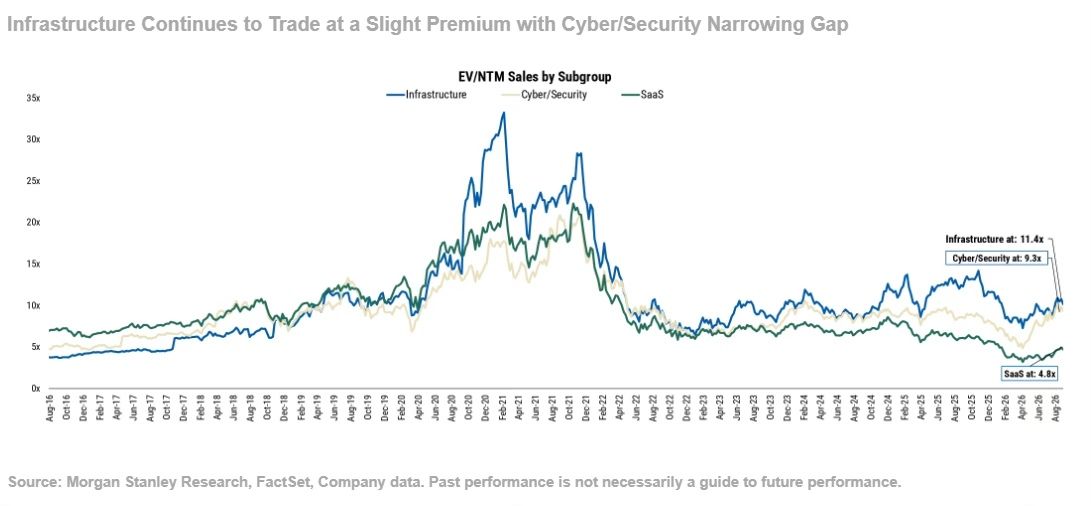
There is a big difference between a public software company that has an infra or cyber moat vs. SAAS as you see below in this table. Private companies, smaller enterprises are obviously much less valuable.
At the other end of the spectrum there are the 1,000+ smaller, sponsor-backed SaaS companies, levered 6x, 8x or 10x debt-to-EBITDA, that are far more susceptible. Their products are often vertical, with a customer base that is more concentrated while their technology is significantly easier to replicate as the cost of software development falls.
As token prices fall, the cost of building, maintaining and replicating software declines sharply. A small team of developers using Cursor, Claude Code or Codex, may be able to recreate comparable enterprise functionality in days rather than years.
Consider a borrower at 10x debt-to-EBITDA. The sponsor may claim 6.5x after add-backs for “one-time” costs that recur annually. A recurring expense is not one-time.
Important questions to consider are:
Will strong historical retention translate into durable ARR over the next five years?
Can margins be defended as enterprise code can increasingly be produced at token prices legacy vendors cannot match?
Will agentic AI reduce seat counts, compress ARR and weaken revenue durability?
If coding costs approach zero, what happens to competitive moats and terminal value?
BDCs and Direct Lending funds hold several hundred billion dollars of software exposure. The risk is now much better understood.
With eyes wide open, few lenders are currently willing to extend new credit on prior terms.
Where new loans are available, they often provide only two to three years of runway, priced at +100 to +200 basis points of additional spread, cash-flow and leverage covenants required, and 5% to 10% annual amortization. New software credit likely support only around 4x leverage, if financing can be obtained.
Existing lenders are willing to waive covenants, permit PIK, or extend maturities in an effort to avoid default, requested a cash sweep if the sponsor is negotiable in an effort to avoid a technical default.
Amend and pretend delays loss recognition. Kick the can down the road has become too familiar a strategy in private credit.
And yes, I am sticking with my call, this maturity wall will lead to a default wall.
|