
Contributors Speak Up: 2025 Potpourri
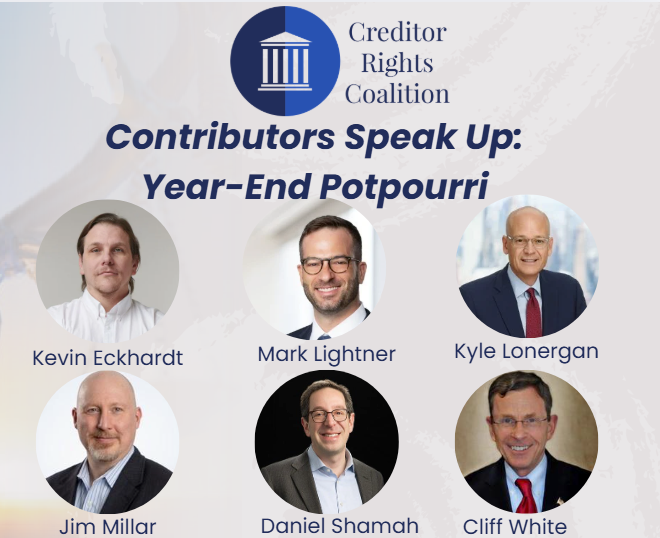
2025 (including the last day of 2024!) featured a flurry of seemingly seminal court decisions—from Serta and Mitel to ConvergeOne, Incora I, and its sequel, Incora II.
We also saw the continued evolution of Liability Management Exercises during 2025, ranging from the aggressive playbook of Tropicana to the more measured approach in Constellium. Are we seeing any coherent themes emerge, or is this simply a Rorschach test where everyone is left guessing what the crystal ball holds?
To help make sense of it all, we asked our expert panel to peer into that crystal ball.
Question #1: After Serta and Better Health, did 2025 meaningfully reset the rules on liability management?
Jim Millar. No. There will be a non-stop effort by companies and majority holders to look for opportunities to take value from minority holders that aren’t at the table. If one version of an LME hits a roadblock, they’ll just look for others.
Kevin Eckhardt. No. Serta is already well on its way to being neutered as precedent. At most, Serta gives creative finance lawyers – and they’d better be creative, at their rates – enough guidance to get around its limitations. Majorities will keep pushing the envelope, and I am not optimistic that courts – especially bankruptcy courts – will fight back if it means blowing up capital structures during a chapter 11, a la Incora/Wesco I.
Daniel Shamah. I think Judge Crane’s Incora ruling did more to reset liability management in 2025. By the time the Fifth Circuit’s Serta opinion came down, sponsors and lenders relying on the open market purchase to do exclusive deals had largely died down. But Judge Crane effectively rejecting collapsing as a way to challenge an LME will have the more lasting impact.
Mark Lightner. No. We simply learned that the words of the debt instruments matter, and courts will enforce them as written.
Question #2: Does the future point toward broader inclusion—or outright prohibition—of cooperation agreements in light of challenges in Selecta and Altice USA?
Jim Millar. I can’t comment on this one given that I represent the plaintiff in Selecta.
Daniel Shamah. I don’t see those lawsuits slowing down coop agreements.
Mark Lightner. It’s difficult to say, but market chatter suggests that Selecta and Altice USA won’t be isolated cases. Until a definitive decision is handed down drawing a line between what’s permissible and not, the primary beneficiaries may simply be antitrust lawyers.
Kevin Eckhardt. The antitrust arguments in Selecta and Altice are ridiculous. The idea that a borrower has a right, under the Sherman Act, to negotiate financing with existing lenders as a “market” is nonsense. Doesn’t mean it won’t work, but until a court disagrees, common sense applies. Coops are fine legally, but I have doubts as to whether they will ever be that widespread. Everyone thinks they’re going to be sitting at the cool kids table when things go bad, so why limit their options? Would Invesco have agreed to a coop with the other AHG members in Robertshaw before it started its move to take the company? Yes, it would’ve prevented Invesco from getting screwed by the other lenders and One Rock, but it also would’ve prevented them from trying to screw the other lenders themselves first. If lenders really want to impose enforceable “play nice” obligations on other lenders, they should put them in the credit agreement itself.
Question #3: Does ConvergeOne’s rejection of a non-pro rata rights offering signal heightened scrutiny of non-pro rata DIPs and exclusive investment opportunities?
Jim Millar. I would say yes. Courts are now realizing that non-pro rata investment opportunities are just another way of favoring some at the expense of others.
Daniel Shamah. Not outside of the plan context, and not at the bankruptcy court level. There’s no equivalent to 1123(a)(4) in the DIP loan context. In the first instance, at least, bankruptcy courts are going to be amenable to approving non-pro rata DIPs to keep cases moving. To the extent prepetition lenders argue that the prepetition credit agreement requires a pro rata DIP, it’s an easy argument to make that that’s an interlender dispute that could be dealt with somewhere else. Now whether higher courts see it the same way, remains to be seen…
Kevin Eckhardt. Heightened scrutiny, in theory. In practice, until bankruptcy judges in big-case venues like Houston understand that in most cases the goodies are not actually necessary to induce the DIP lenders to lend or the backstoppers to backstop, they’ll keep finding excuses to approve them because necessary to avoid liquidation etc. Remember, bankruptcy judges acknowledged that nondebtor releases were limited to “extraordinary circumstances” for decades but nevertheless approved them as a matter of course in virtually every case. This ain’t the Supreme Court, where “strict scrutiny” means “not gonna happen.”
Mark Lightner. It seems like a stretch to extend CovergeOne’s reasonings to pro rata DIP requirements.
Question #4: Do the reversals in Incora, Sanchez, and ConvergeOne suggest greater certainty—or greater volatility—in the SDTX?
Jim Millar. Greater certainty. I view those cases as putting up some guardrails that will need to be respected for the near term.
Kevin Eckhardt. The Fifth is on a rampage, but I don’t expect it to last long enough to turn Houston bankruptcy into a real court of law. If the complex panel survived the Jones mess without acknowledging, let alone correcting, the systemic problems its approach creates, then a few appellate reversals won’t do it either. And where else are debtors going to go to get sketchy relief with a minimum of risk and effort? Delaware and NY are dead. Judge Kaplan is retiring from New Jersey in a year or so. Unless some judge in a single-judge district decides to open for big chapter 11 business, Houston is it. Your move, Idaho.
Daniel Shamah. I think each of those cases stand on their own. They also seem to be a reaction to the…let’s call it “idiosyncratic” rulings of a former judge on that bench. I think there’s more stability in the bankruptcy court there now, which I think will give practitioners more confidence going forward and lead to more predictability at the appellate level.
Mark Lightner. More volatility, but it also means that Article III judges in the Fifth Circuit, true to their reputation, will not hesitate to flex their appellate muscle.
Question #5: Should we welcome the rapid expansion of asset-based lending by non-regulated private players, or are we sowing the seeds of the next financial dislocation?
Daniel Shamah. Way too early to tell, can’t paint that entire part of the industry with such a broad brush. But I will predict that one or two big implosions in the private credit space will lead to a booming industry on think pieces about private credit
Jim Millar. I’m not sure it is either—to me it is just another way of putting money to work. I’m not convinced that it really is all that earthshattering.
Mark Lightner. The growth of asset-based lending among private players offers liquidity to borrowers needing funding diversification or who otherwise lack public market access, but rising capital inflows could weaken underwriting standards and the private nature of the transactions complicates risk assessment. While some credit stress in private portfolios is foreseeable, systemic dislocation seems unlikely.
Question #6: Did 2025 clarify when a dropdown or uptier crosses the line into inequitable conduct—or make those boundaries even murkier?
Kevin Eckhardt. Murkier, if only because we have no idea what reasoning bankruptcy judges will use to get around Serta yet. Serta scared folks straight for a bit, meaning we didn’t get much boundaries-testing on the issue in 2025.
Jim Millar. I think it gave us some data points on specific issues. But each deal is going to turn on ever-evolving language in the debt documents, so more challenges to come.
Mark Lightner. No. Drop-downs and uptiers continue and real boundaries require litigation, but settlements may prevent meaningful creditor protections.
Question #7: Has the line between distressed funds and opportunistic private credit effectively dissolved?
Jim Millar. There’s some overlap for sure, but I bet if you ask them, they will still see themselves as distinct.
Mark Lightner. The line is blurry but not dissolved. As PC defaults rise in a high rate and/or weak M&A environment, more investors holding dis/stressed debt are utilizing tools like amends and extends to keep credits in their portfolios for longer. But when credits face true distress, distressed funds are better equipped for workouts or bankruptcy where recoveries can fall well below par.
Kevin Eckhardt. There never was any difference. “Private credit” is marketing jargon.
Question #8: What single restructuring trend from 2025 is most likely to define 2026?
Mark Lightner. Chapter 11 is not dead.
Jim Millar. I think we’ll see more efforts to restructure outside of chapter 11. Not sure how that will turn out, frankly.
Kevin Eckhart. Exhaustion and frustration with bankruptcy, its extravagant costs, and the absence of reform (or any reasonable prospect of reform) will continue to grow. Alternatives will become more attractive – UK schemes (see Fossil), LMEs, and even straight-up liquidations will see growth. The Code needs reform urgently, but everyone knows it will not happen and the search for viable alternatives is underway. We probably killed the golden goose.
Daniel Shamah. I don’t know if this is what you had in mind, but I think the talent wars will continue to intensify as consolidation in the advisor spaces tightens. The winners and losers are still being sorted out, but the separation between the haves and have nots will continue to widen. It’s a microcosm of what’s going in the legal industry more broadly.
Kyle Lonergan. Continuing and increasing complexity in DIP financing structures; sustained elevated level of commercial filings but countered by increasing pushes to avoid the significant cost of in court restructurings.
Question #9: What question did we forget to ask about restructuring trends as we look ahead into 2026’s crystal ball?
Jim Millar. Given how expensive chapter 11 is these days, I wonder how much have professional fees impacted the choices that companies make.
Cliff White. Here are two broader issues about chapter 11 practice –
(1) Total bankruptcy filings have been steadily marching upward for the past three years. Total chapter 11 filings reached pre-pandemic levels last year. This year, chapter 11 filings are on a trajectory go up by another 10 percent. The trend is significant and unmistakable. Commentators describe various driving forces behind the increases, but there appears to be a high level of business distress. In contrast, bankruptcy filing data also show a 45 percent drop-off in the number of chapter 15 filings so far in 2025 compared to last year. The total number of chapter 15s is small (maybe fewer than 200 this year) so it may be harder to draw conclusions about the reasons for that stark decrease.
(2) As seen in Tricolor and First Brands, there may be a rising number of bankruptcy cases involving alleged fraud. When things go wrong in a company, it suddenly becomes easier to see where the bodies were hidden. Many of us recall the corporate scandals of the early 2000s and the mortgage meltdown preceding the Great Recession. Among the most egregious improprieties were misuse of off-balance sheet transactions and securitizations which are being alleged once again. Chase CEO Jamie Dimon tells us to be ready to find more “cockroaches.” Let’s hope the chapter 11 bankruptcy examiner in First Brands will shed light on the kinds of shenanigans that lenders failed to catch.
Question #10: And finally—pick your poison: what should we call an LME that ends in Chapter 11? A Post-LME Chapter 11? Delay & Default? LME Faceplant? Bankruptcy-Bound LME? Or something else entirely?
Jim Millar. Call it a “LiME Squeeze” The company pulls off an LME, but then gets squeezed by financial distress and ends up in chapter 11.
Daniel Shamah. We now call it a WLME – We Managed our Liabilities into an Eleven.
Mark Lightner. Something else entirely. I like “L’Me File” (pronounced “Lemme File”). Example: “XYZ Corp.’s drop down earlier this year ultimately proved unsuccessful, which resulted in a L’Me File last month.”
Kevin Eckhardt. A distinguished jurist once coined the term “Position-Enhancing Transaction,” or PET, for what we call LMEs. No idea why that didn’t catch on! Anyway, I insist on trying to Make PET Happen by calling out-of-court LMEs “Outdoor PETs” and in-court LMEs “Indoor PETs.” By implication, an outdoor PET that ends up in bankruptcy is a “Neutered PET.”
Cliff White. “A Win for the Professionals” who get paid twice; or “The Ultimate Double-Dip.”
Copyright Creditor Rights Coalition 2026