Weekly News – December 5

Everything Altice: from recent shenanigans to coop challenges we have you covered, First Brands hits the skids, Tricolor standoff, solvent debtor exception lives on, and so much more…

Creditor Corner

Your weekly curated content from the Creditor Rights Coalition

Over 3,500 member subscribers and growing!

We bring you exclusive content from leading data and research providers 

Sign Up Here

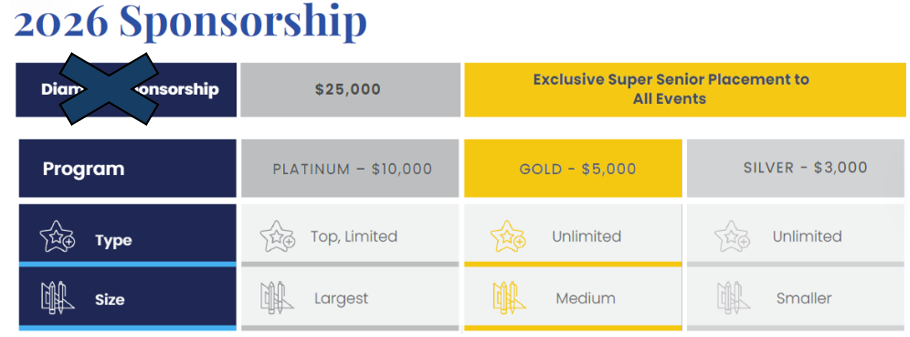
2026 Sponsorships Now Available!


In this Week’s Creditor Corner

Everything Altice: from recent shenanigans to coop challenges we have you covered, First Brands hits the skids, Tricolor standoff, solvent debtor exception lives on, and so much more…


Next Gen Corner:

Pari-Plus Syndications: A Sub Rosa LME?

By Daniel Armanious, NYU Stern

Scroll through to read all of ou?r content?

2026 Sponsorship Packages 

Now Available

Click above to see our Sponsorship Programs

Join our Current Sponsors

Support the CRC’s activities

Platinum Sponsors

Gold Sponsors

Silver Sponsors

Learn more about Sponsorships

Tweet Of The Week

the next big growth area for Rx

What’s happening in Altice?

What’s Happening in Altice?
If you’re having trouble keeping track of all things Altice, don’t worry — in this week’s Creditor Corner, we try to untangle the plot.


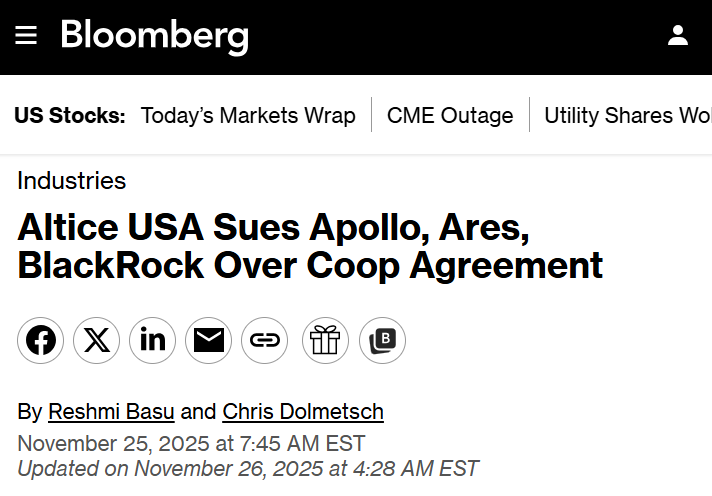
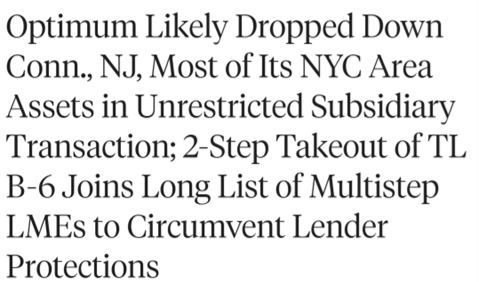
First up: Altice USA (now going by Optimum) made headlines with a coercive dropdown of their crown-jewel assets followed immediately by a Thanksgiving-week antitrust challenge to their existing lenders’ cooperation agreement — because nothing says “holiday spirit” like suing each other over capital structure maneuvering. As part of these shenanigans, Altice USA rolled out a first of its kind anti-cooperation provision in its new debt financing that would cancel the debt held by any breaching lender! 


Meanwhile, in Selecta, we’re seeing the other side of the same coin: excluded creditors arguing that if cooperation agreements are going to exist, then everyone should be invited to the party. Apparently the market can’t decide whether cooperation agreements should be banned entirely (Altice USA style) or turned into a team-building exercise where everyone gets a matching T-shirt (Selecta style).


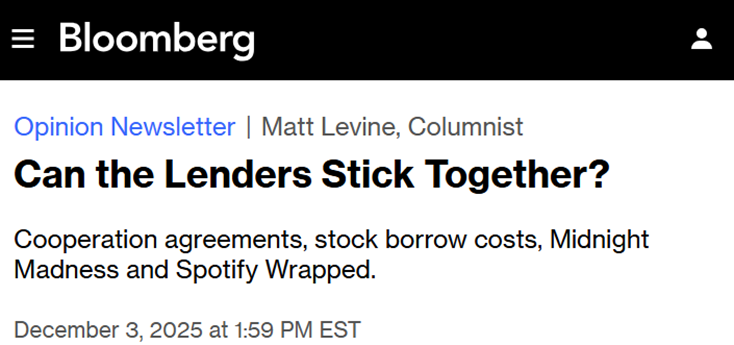
As Matt Levine puts it in this week’s Creditor Corner: “If lenders get together to stop creditor-on-creditor violence, or to commit it, either way there is some antitrust risk.”

And just to make sure we’re all properly confused, let’s not mix this up with Altice France or Altice International. Altice France recently pulled off a consensual restructuring, slimming down its debt from €24 billion to €15.5 billion. Altice International, on the other hand, has creditor anxiety in high gear by shifting 80% of its earnings-generating assets out of the collateral group. Confidence among lenders is… let’s call it “exceedingly wobbly.” 


Fortunately, we will be unpacking all of this drama in our coverage below. 


Bring some popcorn. This is going to be fun!

Continue Reading Below

Exclusive Content

“classic illegal cartel”

Read the Complaint Here

Click above to access content

Additional registration required

Exclusive Content

Altice USA drop-down…

Click above to access content

Exclusive Content

Altice USA “anti-cooperation”

Click above to access content

One time registration required

Exclusive Content

Matt Levine on Creditor-on-Creditor Violence

Click above to access content

Additional registration required

Exclusive Content

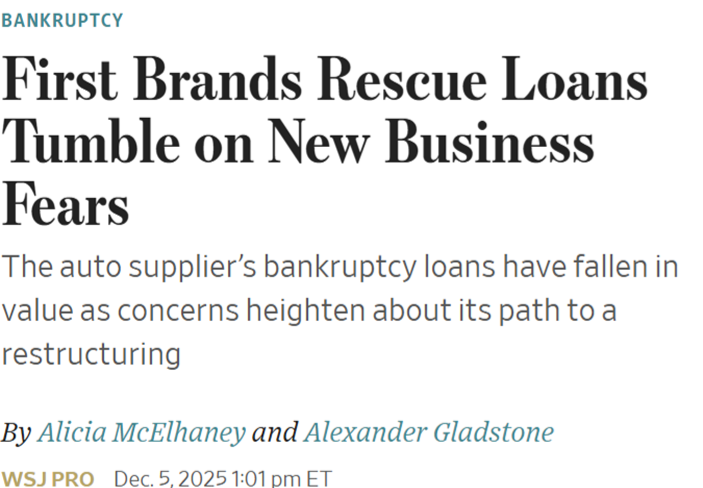
rescue loans need rescuing…

Click above to access content

Additional registration required

Exclusive Content

a Mexican standoff in Tricolor!

Click above to access content

Additional registration required

Exclusive Content

the solvent debtor exception lives to fight another day!

Click above to access content

One time registration required

Our take:

The Solicitor General agrees with the solvent debtor exception!

Exclusive Content

imagine reading these in your docs…

Click above to access content

One time registration required

Exclusive Content

Pari-Plus Syndications: A Sub Rosa LME?


?By Daniel Armanious, a junior studying Finance and Math at NYU Stern.


Sabre priced a $1bn pari-plus senior secured notes offering on November 20th at 11.25%, marking the first fully pre-marketed and broadly syndicated pari-plus financing in the high-yield market. This is more than clever engineering — it is the institutionalization of a structure once limited to bespoke privately negotiated rescue financing. Manufactured structural seniority has now entered the mainstream, and legacy secured creditors have never had more reason to worry.


The Centerbridge Transaction

Sabre’s core business — global travel distribution and airline booking technology — entered 2023 under acute stress. The post-pandemic recovery in air-travel volumes remained muted, and Sabre’s earnings lagged the rebound seen by peers. Liquidity was running thin, and absent a strategic capital solution, Sabre risked being forced into a distressed exchange or worse.


Enter Centerbridge: together with a select club of institutional lenders, Centerbridge structured a first of its kind pari-plus secured financing delivering roughly $700 million of fresh capital, allowing Sabre to refinance $670 million of its 9.250% SSNs due 2025 via cash tender. The tailor-made financing vehicle came with carefully engineered guarantees and structural protections for the new-money lenders (discussed below). With an embedded PIK toggle, the facility provided Sabre breathing room, stabilizing liquidity and allowing EBITDA to normalize alongside travel volume.


While effective, this was still classic private-credit rescue financing — not a market-shaping shift. The lender group stepped in only after pricing the risk as a distressed financing: ~13.25% cash / ~14.75% PIK.


?What is different today is the form, not the concept. The 2025 Sabre syndication takes pari-plus out of the private-credit workshop and turns it into a public, broadly distributed HY product — competitively priced, underwritten by banks, and available to any institutional buyer. That transition represents a fundamentally new dynamic and a far more alarming precedent for secured lenders.


The Evolution of the Double-Dip

Historically, double-dip structures emerged indirectly — often for tax optimization — with their litigation consequences becoming relevant only post-hoc, after distressed funds purchased the paper at a discount and began exploiting entity-level recoveries in Chapter 11.


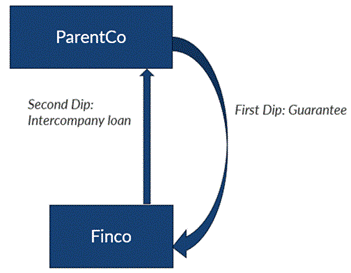
A classic double dip arises from the following financing structure:

  1. A ParentCo guarantees the paper (first dip), and

  2. The FinCo loans the proceeds to ParentCo via an intercompany loan (second dip).

In bankruptcy, the FinCo lenders would be entitled to recover on the guarantee and intercompany claims against ParentCo, therefore benefiting from a double recovery. This is the foundation of the modern double-dip.


Where Pari-Plus Diverges

A pari-plus double dip preserves the double-dip architecture but adds something fundamentally threatening to legacy secured creditors: structurally senior claims against obligors outside the existing credit box, often foreign subsidiaries. This pulls previously unpledged assets into the new pari-plus financing allowing new-money lenders to sit above the existing secured stack without triggering priming mechanics. In the case of Sabre, Centerbridge was able to leap ahead of existing lenders on nearly a third of the company’s EBITDA through this “pari-plus” structure.


Why the Structure Survives Scrutiny

Explain this to a bankruptcy lawyer and you will quickly drown in hypotheticals. Distressed professionals tend to default (no pun intended) to “glass half empty,” and every structure has theoretical attack points. But two simplifying assumptions help clarify why these structures generally withstand such scrutiny:

  1. Guarantees are joint and several — each ParentCo obligor is fully liable for the entire face value of the claim.

  2. These are guarantees of payment, not of collection — enforceable immediately upon FinCo’s default rather than subject to certain conditions.

Sabre’s pari-plus financing relies directly on these principles.


  Why Sabre is Different

This was not a privately-placed back-room exercise like the 2023 Centerbridge facility. Sabre:

?      created the full pari-plus structure,

?      pre-marketed it to the Street, and

?      syndicated it into the public HY investor base.

This is the leap from bespoke LME weaponry to mainstream leveraged finance tooling. The engineering is not new, the distribution model is.


Two Interpretations


The Optimistic View

Debtors — and certainly arrangers — argue Sabre merely used its existing covenant capacity and corporate structure to provide a creative financing solution. If investors will fund structurally advantaged capital at attractive pricing, why should an issuer not pursue such cheap liquidity?


The More-Sinister View

Secured creditors see something far more aggressive: a company and often sponsor, subject only to capacity constraints, can now dilute secured recoveries on a syndicated basis, with no sacred-rights consent, no priming fight, and no dropdown transaction. The fulcrum now sits wherever the issuer chooses to manufacture it.


In-Court Implications: Murky and Dangerous

To date, no court has directly ruled on a modern, deliberately constructed pari-plus financing in a fully contested Chapter 11.

Whether courts will:

?     respect these synthetic seniorities,

?     collapse corporate separateness,

?     recharacterize intercompany loans as equity,

?     or attack the structure as a constructive fraudulent transfer,

is simply uncertain, particularly in the wake of more recent creditor-protective rulings (e.g., ConvergeOne, Serta) — in the SDTX, no less. You can read more about the legal uncertainties here: https://creditorcoalition.org/treatment-of-double-dips-in-bankruptcy/.


?What is certain: pari-plus gives new-money lenders considerably more negotiating leverage. The “Deal Away” was once a theoretical threat — now it has credible firepower behind it. 


Why This is Historic for HY

The Sabre issuance demonstrates that the market is now willing to pay for engineered structural seniority, not merely covenant protection. Banks have also shown they will underwrite and distribute these instruments to the broad HY investor base. This is the moment when double-dip engineering stops being boutique liability-management craftwork and becomes a standardized, repeatable product embedded directly into BSL structures. If history is any guide, the question is not whether the loan market adopts this technology, but when.


Bottom Line

For the HY market, this is a regime change. For secured creditors, it is an existential warning. For future restructurings, it marks the arrival of a structurally senior financing tool that courts have not yet fully confronted — but soon will.

Sabre didn’t invent the economics — it institutionalized them. By syndicating a pari-plus structure into the public HY markets, Sabre created the first widely distributed priming instrument that circumvents the traditional LME mechanics entirely: the first Sub Rosa LME.


Copyright Creditor Rights Coalition 2025


What we’re watching

Joseph Glatt, Co-Chair of Paul, Weiss global Private Credit Group

Click above to access content

Upcoming Events

Register by clicking above

Register by clicking above

Register by clicking above

Register by clicking above

The Data Download

Bringing Transparency to the Bankruptcy Process

Click Above to Access The Data Download

Our Take:

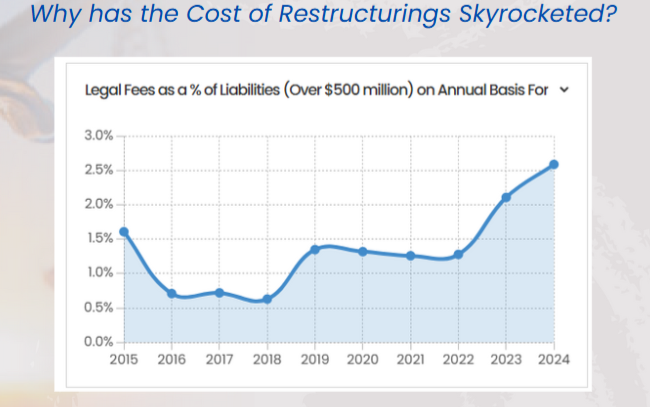
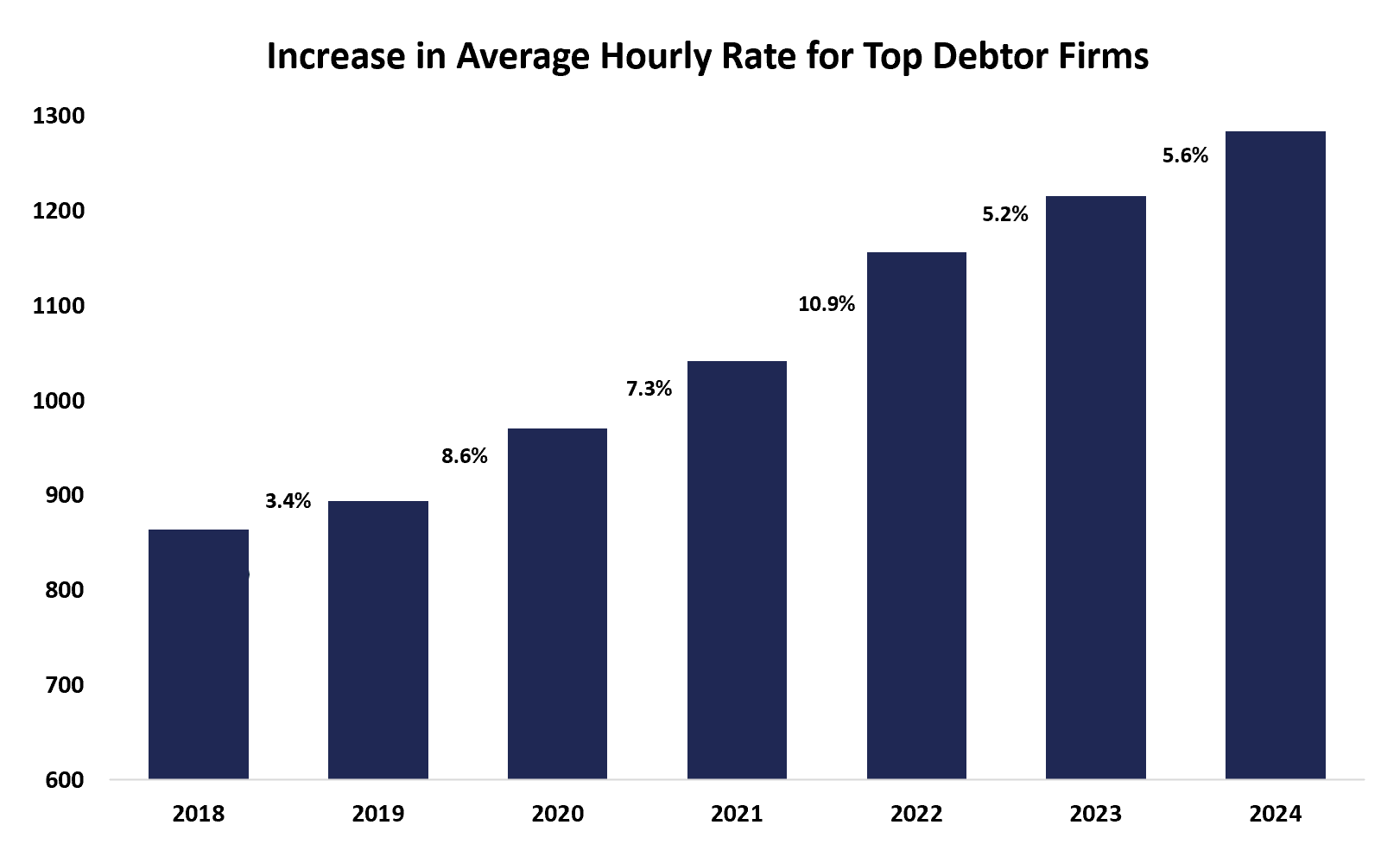
The Daily Cost of BK Legal fees Are Increasing.

Are we shocked? No.

We took a deep dive to see what is driving up the daily cost of restructurings and the culprit: Increasing Legal Hourly Rates. We analyzed final fee apps for top debtor law firms from 2018 to 2024 and found average hourly legal fees have increased by over 65% since 2018. Maybe a little bit of sunlight is the right disinfectant to help remedy the problem….

Meet Our 2025 Contributors


Have Something to Share?

Email us at info@creditorcoalition.org